

You've just closed a client call, and there's a Slack notification about an invoice, and the landing page still isn't done, and someone wants a proposal by Friday. You open your to-do list. It has 43 items on it. You close it again. That's not a productivity problem. That's an architecture problem.
Creating a productivity system for entrepreneurs means building the structure your job never gave you. No manager assigns your priorities. No one tells you when to stop. You are the entire operations department, and the system is what keeps that from collapsing into a permanent reactive state.
I've built three versions of my own over the years. The first one was a graveyard of apps. The second one was so rigid I abandoned it in a week. The third one is what I still use, and it survives precisely because it's a bit ugly.
Key takeaways
- A productivity system is the set of decisions you make once so you don't remake them every morning.
- The binding constraint for most founders isn't time — it's decision fatigue from context-switching across five roles.
- Weekly review is the load-bearing wall. Remove it and the whole thing slowly rots.
- The 3-3-3 rule and the 7-8-9 rule are useful planning scaffolds, not laws. They work best as defaults you deviate from consciously.
- Software should follow process, never replace it. Picking tools first is the most common failure mode.
Why entrepreneurs need a productivity system more than anyone else
Employees inherit structure. Their week is partly decided by meetings, deadlines, and a manager who notices when nothing ships. Founders inherit nothing but a blank calendar and an infinite list of things that could matter.
That blank calendar is a trap. Without imposed boundaries, the default state becomes reactive: whoever shouts loudest gets your morning. By the time you look up, the thing that would actually grow the business — the pitch, the product decision, the hire — hasn't been touched in three weeks.
The real problem is role-switching
On a given Tuesday you might be the strategist, the salesperson, the bookkeeper, and the person answering a customer support email at 11pm. Each switch carries a cost. Not a dramatic one, but a cumulative drag that leaves you busy and oddly unproductive.
A working system does one thing well: it batches similar decisions together so your brain isn't constantly reloading context. Finance on Monday afternoon, not scattered across the week. Sales calls clustered. Deep work protected in a block that nobody can book over.
System versus to-do list
These get confused constantly. A to-do list is a container. A system is a set of recurring decisions with a rhythm attached.
- A to-do list answers "what now?" — and it answers poorly when it has 43 items.
- A system answers "what gets my attention this week, and what deliberately doesn't?"
- The list without the rhythm becomes a guilt document. The rhythm without the list is airy and falls apart.
If you take one thing from this section: build the rhythm first. The list is easy. The cadence is the work.
How to build your own system, step by step
Here's the version I'd hand to any founder starting from zero. It's not glamorous.
Step one: define the three outcomes
Not goals. Outcomes. Things that would be visibly true in ninety days if the business moved forward. Three is a good ceiling because it forces the ranking. Five means you haven't decided.
Write them somewhere you'll see during your weekly review. Then, and this is the part people skip, decide what you are explicitly not pursuing this quarter. Write that down too. A system that doesn't say no to anything isn't a system.
Step two: design your week in blocks
Take your calendar and place the non-negotiables first. A deep work block of ninety minutes to two hours, ideally at the same time each day. One block for the operational admin that never ends. One block for sales or business development. One for the weekly review.
The exact hours matter less than the repetition. My own deep work block starts at 9:15, not 9:00, because I learned the hard way that I need a slow first half hour to triage whatever landed overnight. It's a small detail. It's the difference between a block I keep and a block I abandon.
Leave roughly a third of the week unbooked. Yes, really. Everything takes longer than expected and inbound requests are not optional for a founder. A fully booked calendar is a fragile calendar.
Step three: run a weekly review
Forty-five minutes, same slot every week. Three questions:
- What actually moved on the three outcomes?
- What did I spend time on that I couldn't have predicted?
- What gets dropped, deferred, or delegated next week?
That third question is the one that keeps the system alive. Without it, you carry accumulated commitments forever and the workload compounds silently. I once let this slide for six weeks during a product launch. The review took ninety minutes when I finally came back to it, and most of that was untangling promises I'd half-forgotten.
There's a useful box on this. Set yourself a hard stop, because a weekly review can easily turn into a second workday.
The 45-minute weekly review, timed
- 5 minutes — clear the inbox to zero (archive, defer, or turn into a task).
- 10 minutes — scan the calendar for the coming week and pre-empt conflicts.
- 15 minutes — check progress on the three outcomes and update the project list.
- 10 minutes — decide what gets dropped or delegated.
- 5 minutes — choose the single most important thing for Monday.
What is the 3-3-3 rule for productivity?
The 3-3-3 rule is a daily planning scaffold: three hours of focused work, three shorter or lighter tasks, and three maintenance activities (admin, email, errands, the small things that keep the business from stalling). The exact split varies by who's describing it, but the principle is a day with a firm spine and a flexible tail rather than a flat list of twenty items.

What makes it useful for a founder is that it accepts reality. Three hours of genuine focus is a lot when you're also handling sales and support. And it forces the maintenance category to exist visibly instead of bleeding into everything else.
Where it breaks
Three hours of focus is hard to protect if you have a small team and real inbound pressure. I tried it strictly for a month and kept failing the deep work block, which turned the whole rule into a daily reminder that I wasn't hitting the target. The fix was to treat it as an aspiration with a floor: three hours when the day allows, one uninterrupted hour absolutely guaranteed. Missing the ceiling is fine. Missing the floor is not.
What is the 7-8-9 rule for time management?
The 7-8-9 rule is a way of splitting the working day into three segments — roughly seven hours of work, eight hours of sleep, and nine hours for everything else: personal life, meals, family, rest. It's a sanity check on the total of a day rather than a scheduling method, and the eight hours of sleep is the part people quietly ignore.
Its value is blunt: if a "system" requires you to cut sleep to make it work, the system is wrong. Founder culture has a long habit of treating sleep as negotiable. The 7-8-9 split says plainly that a functional day has a fixed ceiling, and everything beyond it is borrowed from tomorrow's clarity.
In practice, I use it as a boundary rule rather than a time budget. When the nine hours start shrinking consistently, that's the signal that the workload is no longer sustainable and something structural has to change — a delegation, a hire, or a decision to stop doing a thing.
What the week looks like in practice
An illustrative layout, not a prescription. Adjust the blocks to your hours and your energy pattern.
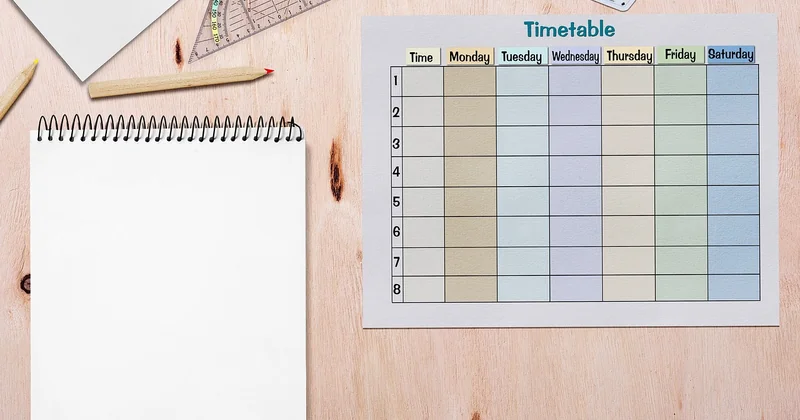
| Day | Deep block | Operational block | Other |
|---|---|---|---|
| Monday | Product or core work, 90 min | Inbox and admin, 60 min | Finance and bookkeeping in the afternoon |
| Tuesday | Product or core work, 2 h | Client calls clustered | Unbooked buffer |
| Wednesday | Product or core work, 2 h | Team sync and follow-ups | Afternoon left open |
| Thursday | Sales and business development | Admin, 60 min | Unbooked buffer |
| Friday | Light — writing and planning | Weekly review, 45 min | Week ahead mapped before logging off |
Notice that the deep work blocks sit early and repeat. Repetition is what makes a block survive contact with a real week.
Can you give me 10 examples of productivity software?
Here are ten widely used categories and representative tools, in alphabetical order rather than ranked, because the best one depends entirely on the role you're filling.
- Asana — project and task management with a reasonable free tier for small teams.
- ClickUp — packs tasks, docs, and whiteboards into one place; powerful, and correspondingly configurable to the point of overwhelm.
- Google Calendar — unglamorous and the backbone of any block-based week.
- Notion — notes, databases, and a wiki that doubles as a company handbook.
- Obsidian — local-first markdown notes for people who want ownership of their files.
- Todoist — fast capture and solid recurring-task handling.
- Toggl Track — time tracking, useful for discovering where the week actually went.
- Trello — simple kanban boards; excellent when the process is simple and you don't want to fight the tool.
- Zapier — automation between the tools you already use, so routine handoffs stop needing you.
- Apple Notes or a plain text file — genuinely underrated for the daily scratchpad.
Choosing without wasting a month
The temptation is to trial all ten. Don't. Pick one task manager, one notes app, one calendar, and one timer. Live with them for a month before changing anything. The tool-hopping phase is a form of procrastination that feels like progress.
A rule I now enforce on myself: no new tool until I can name the exact decision the current one makes harder. Vague dissatisfaction doesn't count. That single constraint has saved me weeks.
What are the most effective productivity tools for entrepreneurs?
For a founder, the highest-value tools aren't task managers — they're the ones that reduce your presence as a bottleneck. Automation and documentation beat any nicer to-do app.

- An automation layer (Zapier, Make, n8n) — anything you do the same way every week is a candidate.
- A written handbook — the moment a task needs explaining twice, it belongs in a document, not in your head.
- A calendar with protected blocks and visible buffer — the cheapest system upgrade available.
- One notes system you trust — scattered notes are a slow tax on every decision.
- A time tracker used for two weeks, then dropped — the point is the diagnosis, not the habit.
The last one is worth the awkwardness. Two weeks of tracking usually reveals a category of work you didn't know you were doing, and often it's the most delegable.
The mistakes that quietly kill a system
The most common one: building a system for the entrepreneur you'd like to be rather than the one you are. If your plan assumes four hours of uninterrupted focus and your reality is three twenty-minute windows, the plan is fiction and you'll abandon it within a fortnight.
Second: skipping the weekly review two weeks in a row. It never feels urgent, which is exactly why the practice dies. Guard it like a client meeting.
Third: treating the system as finished. It isn't. Every few months something shifts — a new hire, a new client, a product change — and the calendar blocks need renegotiating. I rewrite mine roughly quarterly, and it's never a big job when I do it on schedule.
Start with one calendar block and one weekly review. That's a whole system on day one, and it's more than most founders have. The rest can wait until the rhythm holds.


